How many elective courses among E1 to E6 had a decrease in their enrollments after the change process?
Answer: C
Let us first try and tabulate the number of people for each of the electives before and after the change in elective
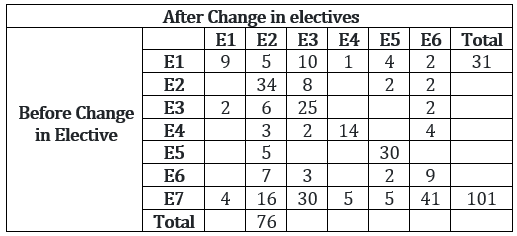
ow we know that after change of electives number of people choosing E2 increases by 30. This means that before change of electives, number of people choosing E2 is 76 – 30 = 46.
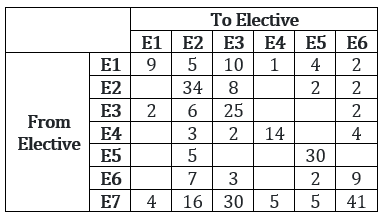
Now if we check row E2, the values 34, 8, 2 and 2 add upto 46. Since the values of blank cells can be 0 or 1, it means that the remaining 2 cells in row E2 will be 0.
Now before the change, E1 had 6 more students than E4, which means E4 had 31 – 6 = 25 students. If we look at the row E4, there are 2 blank cells. Also, the total of the remaining 4 cells adds upto 3 + 2 + 14 + 4 = 23. As total of all 6 cells has to be 25, it would mean that remaining 2 cells can only have a value of 1. Also the number of students before change of elective in E6 is 25 – 2 = 23. Again in row E6, sum of 4 occupied cells = 7 + 3 + 2 + 9 = 21. Here too with only 2 vacant cells, the balance 2 cells will have a value of 1 each. Now in E2 there are 10 students more than E3 before change of electives, which means in row E3 the total will be 36. This further implies that in row E5, total will be 300 – (31 + 46 + 36 + 25 + 23 + 101) = 38

So far, the total of columns E1 to E6 is 17 + 76 + 78 + 21 + 44 + 60 = 296
This means that the remaining 6 vacant cells in the table will be filled up four ‘1’s and two 0’s. Since the number of students after the reshuffle in E1 is 3 less than the number of students in E4 (which is 21 without the 2 blank cells), the total of column E1 has to be at least 18 which means the vacant cell in column E1 will be filled with 1. This further implies that the balance 2 cells in column E4 will be filled with 0. So then the remaining cells in column E3, E5 and E6 will be filled with 1. Our final table will appear as below.

Now using this table let us answer each of the questions
If we look at the table there is a decrease in the number of students for electives E1 (which decreases from 31 to 18) and E4 (which decreases from 25 to 21).
Hence, option (c).