Q1
Find the internal angle of a regular hexagon (in degrees).
Answer: 120
We know internal angle of a regular polygon =
∴ Internal angle of a regular hexagon = = 120°.
Hence, 120.
Answer each question to see the solution straight away. Use the keyboard to move faster.
Find the internal angle of a regular hexagon (in degrees).
Answer: 120
We know internal angle of a regular polygon =
∴ Internal angle of a regular hexagon = = 120°.
Hence, 120.
In the given regular hexagon ABCDEF, what is the ratio of the triangle ACE to that of the hexagon ABCDEF?
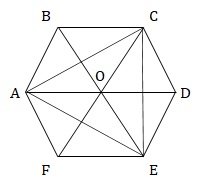
Answer: C
Since the given figure is symmetric, we have 12 smaller triangles all of whose area is same.
⇒ The hexagon is divided into 12 smaller triangles of equal areas.
∴ Area(Hexagon) = 12a
Also, Area(∆ACE) = 6a
⇒ Area(∆ACE) : Area(Hexagon) = 6a : 12a = 1 : 2.
Hence, option (c).
If area of regular hexagon ABCDEF is 36 cm2. What is the area of right triangle AMB (in cm2)?
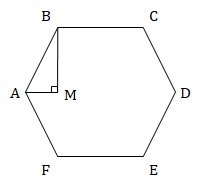
Answer: 3
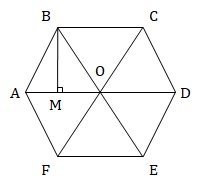
In the figure above,
Area(∆AOB) = 1/6th of area of hexagon = 6 cm2.
Also, Area(∆AMB) = ½ of area ∆AOB = 3 cm2.
Hence, (c).
What is the area (in cm2) of a regular hexagon with perimeter 36 cm?
Answer: C
Perimeter of a hexagon = 6 × side
∴ 6 × side = 36
⇒ Side of the hexagon = 6 cm.
Now, area of the regular hexagon = = = 54√3.
Hence, option (c).
In regular hexagon ABCDEF, P, Q, R are the mid points of sides DE, FA, BC. What is the ratio of the area of Δ PQR to the area of the hexagon.
Answer: A
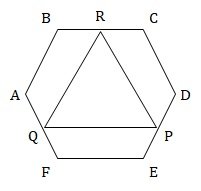
Suppose side of the hexagon = a.
In trapezium ABCF, CF = 2a and AB = a and R and Q are the mid points of oblique sides.
∴ RQ = (AB + CF)/2 = (a + 2a)/2 = 1.5a
⇒ = =
Hence, option (a).
An equilateral triangle of side 12 cm. has its corners cut off to form a regular hexagon. Find area and perimeter of hexagon?
Answer: B
Let the side of the hexagon obtained be 'x'.
Since, DE || BC, ∆ADE will be an equilateral triangle.
∴ AD = DE = AE = x

⇒ Side AB is divided equally in three parts, hence the side of the hexagon will be one-third that of the triangle.
∴ Side of the hexagon = 1/3 × 12 = 4 cm.
⇒ Area of the hexagon = 6 × √3/4 × (4)2 = 24√3
⇒ Perimeter of the hexagon = 6 × 4 = 24
Hence, option (b).